Privacy is an Engineering Problem.
Lawyers write the policies. Engineers execute them.
The penalty for a GDPR violation isn’t levied against the legal team—it hits the company's bottom line, driven by infrastructural failure. Stop trying to parse Article 32 through a legal lens. Start implementing concrete data maps, encryption protocols, and automated deletion pipelines.
Read the GDPR Engineering SpecThe Cost of Ambiguity
When privacy requirements are vague, implementations are weak. Regulators don't care about your intent; they audit your logs.
€1.2B
The largest GDPR fine to date (Meta, 2023), resulting from cross-border data transfer mechanisms failing technical scrutiny under Schrems II.
Fix Transfer Mechanisms →45 Days
The CCPA statutory window to respond to a verifiable consumer request. Manual database queries scale until they break. Automation is mandatory.
Automate DSARs →74%
Of data breaches involve the human element or misconfigured databases. Encryption at rest is the baseline, not the ceiling.
Encryption Specs →Architectural Requirements by Jurisdiction
A mapping of legal statutes to required database architecture.
| Requirement | GDPR (EU) | CCPA (California) | Technical Implementation |
|---|---|---|---|
| Right to Erasure | Article 17 | 1798.105 | Cascading soft-deletes with 30-day hard purge cron jobs. Spec → |
| Data Portability | Article 20 | 1798.100 | Automated JSON export generation via asynchronous queues. Spec → |
| Consent Management | Article 7 | Opt-out focus | Stateful JWT claims mapping to specific vendor categories. Spec → |
| Breach Notification | 72 Hours (Art 33) | No specific window | Intrusion Detection Systems (IDS) linked to PagerDuty. Spec → |
You Can't Protect What You Can't See.
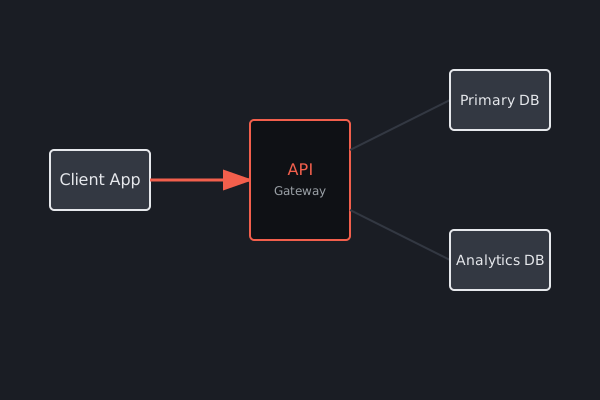
A data map is not a spreadsheet. It is a live, automated graph of your infrastructure showing exactly where PII enters, mutates, rests, and exits your network.
- Identify all ingress points (forms, APIs, webhooks).
- Classify data types (PII, PHI, PCI, Anonymous).
- Map third-party vendor destinations.
Catastrophic Fails in Production
Cryptographic Naivety
Hashing passwords with MD5 or SHA1 instead of bcrypt/Argon2. Using ECB mode in AES instead of GCM. Your crypto implementation is likely flawed unless strictly reviewed.
Review Crypto Standards →The "Delete" Flag
Setting is_deleted = true does not satisfy the GDPR Right to Erasure. The data still exists on disk and in backups. You must permanently purge the row.
Third-Party JS Sprawl
Dropping Google Analytics, Meta Pixel, and Hotjar directly into your <head> without a Tag Manager gated by explicit user consent violates ePrivacy directives instantly.
Tool: GDPR Fine Exposure Calculator
Calculate theoretical maximum exposure based on global annual turnover.
Outsource Identity.
Rolling your own authentication is a liability. Storing passwords, managing session invalidation, and handling MFA securely are complex domains. Leverage OIDC/SAML providers (Okta, Auth0, AWS Cognito) to shift the risk profile of identity management.
Auth Architecture →- SAML 2.0 — Enterprise standard. Heavy XML, robust assertions.
- OIDC — Modern web standard. Built on OAuth 2.0, JSON based.
- WebAuthn — Passwordless future. Hardware-backed biometrics.
The Anatomy of Legal Consent
Dark patterns invalidate consent. Pre-ticked boxes are illegal in the EU. A compliant consent mechanism is binary, explicit, and granular.
"By continuing to use this site, you accept our use of cookies."
Subprocessors & Supply Chain Risk
If your vendor gets breached, you get breached. The GDPR holds the Controller (you) responsible for the actions of Processors (your vendors). Technical audits of third parties are mandatory.
Audit Checklist
1. Do they possess SOC 2 Type II or ISO 27001 certifications?
2. Are Data Processing Agreements (DPAs) signed and executed?
3. Do they sub-process to a 4th party? (e.g., Vercel uses AWS).
4. Where is the physical data residency? US? EU? APAC?
5. Do they support automated deletion via API?
API Privacy Leaks
APIs are the primary vector for mass data exfiltration. Broken Object Level Authorization (BOLA/IDOR) allows attackers to iterate through user IDs and scrape millions of records.
Secure Your APIsGET /api/users/1337
// SECURE: UUIDs and Authorization Context
GET /api/users/8f14e45f-ea34-4b52
Authorization: Bearer eyJhbG...
// Server verifies token belongs to 8f14...
Zero-Knowledge Architectures
If you hold the keys, you can be forced to decrypt the data. End-to-End Encryption (E2EE) ensures that the server acts only as a dumb relay. The decryption keys exist only on the client's device.
Signal Protocol
The gold standard for asynchronous messaging encryption using Double Ratchet algorithms.
WebCrypto API
Native browser capabilities for generating key pairs and performing AES-GCM encryption client-side.
Architectural FAQ
Stop Guessing. Start Building.
Deploy compliant infrastructure from day one. Browse the technical specifications.
Explore Specs